

 by
by 
If you’ve ever wanted a simple go-to recipe for lentils, look no further than this spicy black lentils recipe!
The definition of simplicity, these lentils need minimal ingredients and come together quickly.
Not to mention the fact that they’re great for meal prep and super versatile. Whether you want to pair them with rice or wrap them in pita with greens, these lentils smack lol.
Made using tadka (I’ll go in-depth into what this is in the blog post), red onion, and cilantro, you’ll be obsessed with these Indian black lentils.
Spicy Black Lentils Ingredients
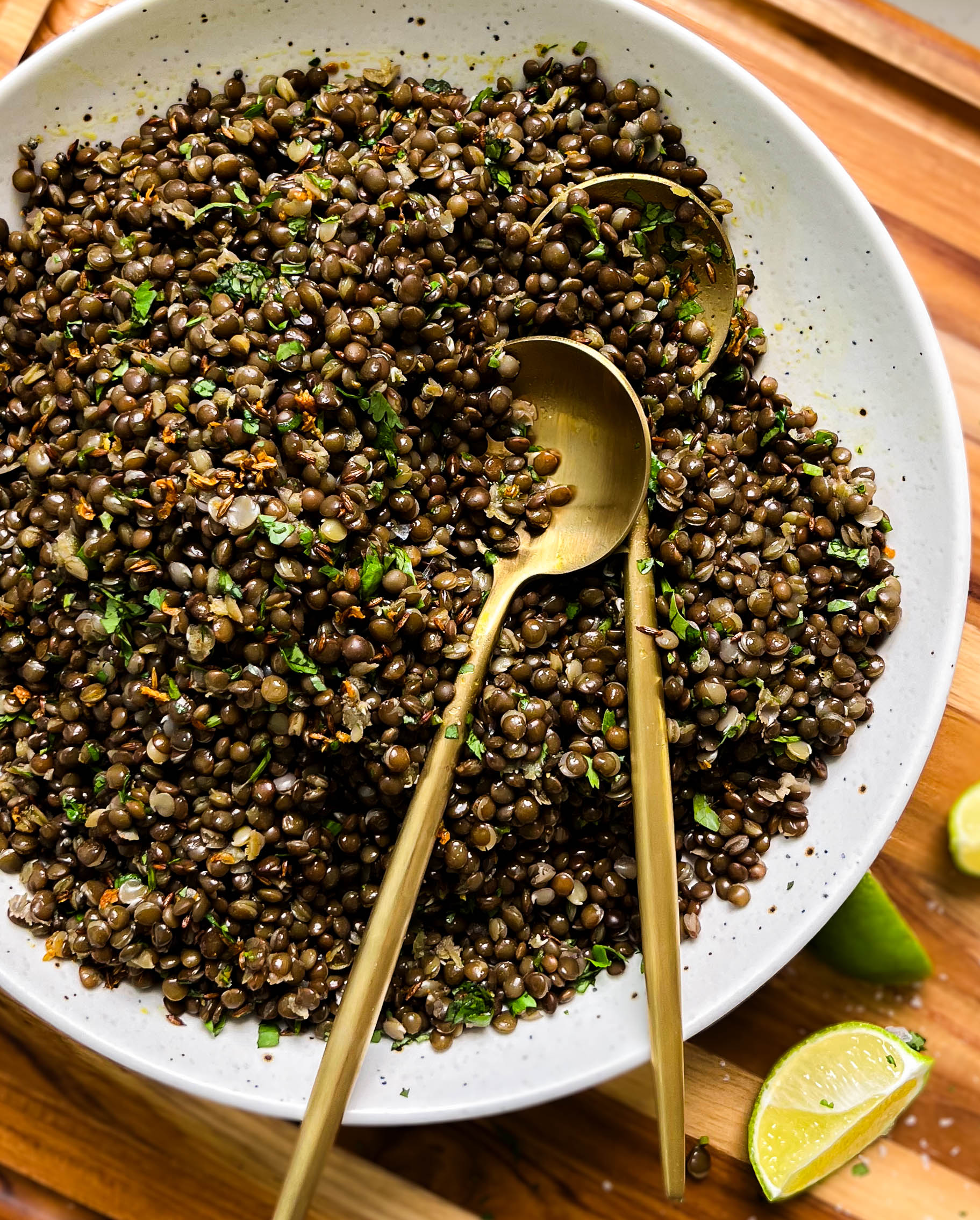
Here’s everything you’ll need for this black lentil salad! As you’ll see the majority of the ingredients are spices and it’s imperative that you use whole spices for optimal flavor.
- Black lentils: Green lentils or beluga lentils also work well
- Red onion
- Cilantro
- Avocado oil
- Cumin seeds
- Mustard seeds
- Coriander seeds
- Cayenne pepper
- Garlic
- Turmeric
- Salt
The Method Behind These Spicy Black Lentils
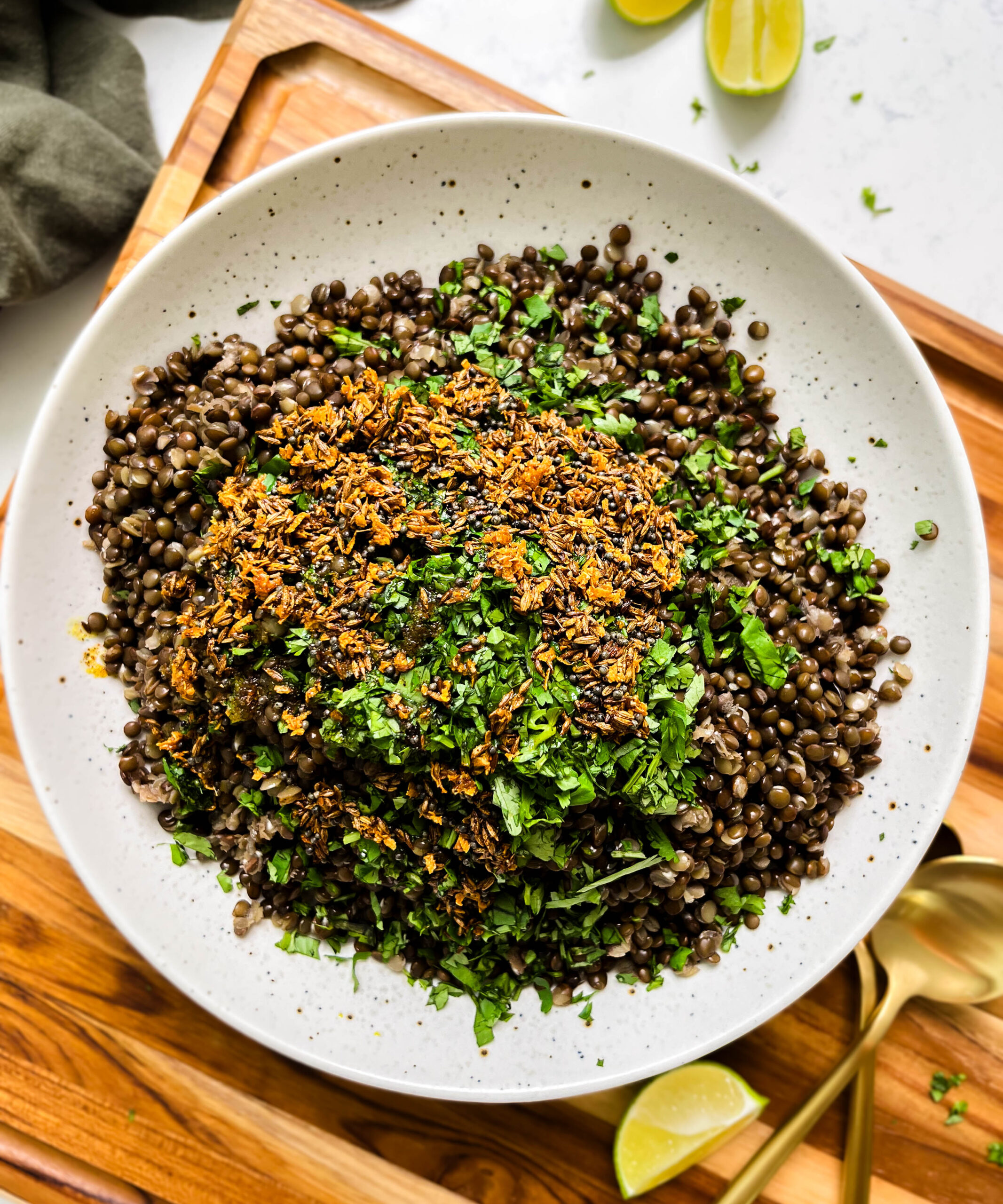
These lentils start by cooking the lentils, duh! Then it’s time for the star of the dish, the tadka, aka tons of aromatic spices bloomed in avocado oil. This gets poured over top of the lentils, along with cilantro, red onion, and salt. That’s it!
But let’s get into what‘tadka’ is, the backstory, the science, and how to use this method properly!
Backstory On Tadka
Ok, so what is tadka, also referred to as chaunk (chhonk)?
Tadka is not an actual dish or recipe but rather a method of blooming spices in oil or ghee to create an aromatic flavor-packed sauce. Usually poured over dal to add richness and complexity! Depending on the types of spices, herbs, and fat used, the tadka can change dramatically in terms of flavor, texture, and color.
One good way to think of tadka is as a layer of flavor. Just like many soup recipes, stocks, etc. start with browning veggies to build more flavor. Tadka does the same but on a more intense level in my opinion.
Oh and as a note, tadka refers to both the method and the spiced oil.
Small Note
And lastly, I wanted to point out that in many Asian countries, spices are bloomed in hot oil. So of course there are numerous names for this technique.
This method I’m sharing is rooted in Indian culture and is called many different names depending on the region/language. Some common names for this method are tadka, chaunk, phanna, baghar, and other names for this technique and powerful flavor agent!
The Science Behind Tadka
There are three main players in tadka: heat, fat, and spices. So here’s what you need to know about each of these three components.
Heat
Using heat produces reactions; caramelization and the maillard reactions. These reactions happen to all foods. And for these spices in tadka, their essential oils inside are transformed chemically through heat.
One additional note for using heat for tadka is that most spices (and herbs) are dried. Drying spices ‘freezes’ the flavor molecules in place and increases their shelf life. But also conversely, depletes their flavor and aroma. Blooming spices in oil at high heat can ‘unfreeze’ and help draw out the spices’ flavor and aroma.
Fat
As I said above, most spices are dried and need to have their flavor/aroma extracted. And since most flavor molecules in spices are fat-soluble, they can easily be extracted using fat. I recommend choosing your fat wisely! In most cases, I like to use neutral fats like avocado or olive oil.Ghee, coconut oil, and sesame oil are more flavorful fats that will lend their flavor to the tadka — just something to keep in mind!
Spices
Ok, the last component! Spices!
Whole spices like cumin seeds, coriander, and mustard seeds are the usual. But lightly cracking them can help with infusing the oil with even more flavor.That said, if you use ground spices, they will cook faster and release flavor more quickly than whole spices.
Additionally, fresh ingredients and herbs, like garlic, onion, and ginger can be added to tadka for extra flavor and texture. Typical spices and aromatics you’ll see in tadka are coriander, cumin, fennel, mustard seeds, cardamom pods, turmeric, onions, shallots, ginger, chilies, bay leaves, curry leaves and garlic. To just mention a few lol.
Ok, enough yap! Can’t wait for you to make these lentils – you’ll love them! Don’t forget to leave a starred review and rating, love hearing from you!
Print
Spicy Black Lentils
- Prep Time: 20
- Cook Time: 35
- Total Time: 55 minutes
- Yield: 4 1x
- Category: Dinner
- Cuisine: Indian
Description
The definition of simplicity, these lentils need minimal ingredients and come together so quickly. Not to mention the fact that they’re great for meal prep and super versatile. Whether you want to pair them rice or wrap them in a torialls with greens, these lentils smack!
Ingredients
- ½ medium red onion (optional)
- 1 head fresh cilantro, leaves only
- 1 cup black lentils (soaked overnight if you can)*
- 4 tbsp avocado oil
- 1 dried bay leaf (optional)
- 2 tsp cumins seeds
- 2 tsp mustard seeds
- 2 tsp coriander seeds
- 2 fresh garlic cloves, finely minced or grated
- 1 tsp cayenne pepper
- ½ tsp ground turmeric
- Diamond Crystal kosher salt to taste, about 1 tsp
Instructions
- Rinse the lentils. Rinse the lentils in a large colander until the water runs clear – this is especially important if you soaked your lentils overnight.
- Cook the lentils. Dump the rinsed lentils into a pot, cover with water and bring to a boil over medium-high heat. Once boiling, salt the water, and let the lentils cook until soft, but still have some bite. Drain and turn out onto a towel to ensure there is no residual water. Then dump into a large mixing bowl along with the onion and cilantro. Set aside.
- Make the tadka. Using the same pot you used to cook the lentils (save yourself some dishes, just make sure it’s completely dry) add the avocado oil. Place the pot on the stove and turn on medium heat. Once the oil is shimmering and hot add in the cumin seeds, coriander seeds, mustard seeds, cayenne pepper, turmeric and fresh garlic. If you want you can also add a bay leaf. Let the spices bloom for 1 – 1 1/2 minutes. Any longer and the spices will start to burn and have a bitter undernote. NOTE: One good way to test if the oil is hot enough is by dropping in one or two whole spice seeds (based on what you’re using) such as cumin, coriander, or mustard. The spices will sizzle immediately if the oil is sufficiently hot.
- Toss everything together and serve. Once the tadka is done, pour over the bowl of lentils and sprinkle with salt. Toss to combine and adjust seasoning to taste. Enjoy these lentils on their own, with rice or with pita bread. Store these lentils in an airtight glass container in the fridge for up 5 days.
Notes
*I recommend soaking the lentils overnight – soaking makes the nutrients more bioavailable and easier on digestion.
Pingback: Foods I Eat Every Day (to optimize health) | Munching With Mariyah
Pingback: Shirazi Salad | MWM
Pingback: Vegan Pasta Salad | MWM
Pingback: Vegan Dal Makhani | MWM
Love it love it love it. Delicious thankyou so much. Your recipes are an inspiration.
Made my day to read this, thank you so much Maureen!!
Hi! There is a discrepancy in the blog section verses the recipe section. The Blog states 15 minutes cooking, but the recipe section states 20-25 minutes to cook. Which is correct? Also, how much water do I add to the pot for boiling?
I look forward to making this soon!
Thanks so much for flagging that, just updated the blog text to reflect the 20 minute cook time. I fill up the water about 2 inches above the lentils so they have enough room to boil – think of it like cooking pasta. Super excited for you to make this dish, it’s one of my favorites!!
Can’t get enough of this recipe! Will be making this often. Thank you for this recipe!
How much is a “head” of cilantro? A typical bunch bought at a store? Can you give teaspoon or tablespoon equivalent?
1 head is equivalent to 1 cup firmly packed cilantro leaves.
My husband was dubious. He ate a forkful and said, “wow, these lentils are really good.” We both liked them as they were flavorful and had a nice level of spiciness that wasn’t too much to taste the flavors of the spiced oil. Very nice. We ate the lentils with some tandoori chicken kebabs.
Can I substitute ground coriander, ground, mustard, and ground cumin for the seeds? What would be the substitute equivalent? Your recipe looks delicious!
Yes you can! Use 1 ½ tsp ground cumin, 1 tsp ground coriander, and 1 tsp ground mustard. So excited for you to make this!
Wow! This dish is exquisite. Thank you!
(I added a little 🍋)
Ah so happy you liked it – thank you SO much for leaving a review ☺️
Hi, I’m just about to start making this.
Can you please clarify what you do with the “optional red onions”?
Thank you!
oops, sorry, I just found the onions in the recipe. please ignore my previous comment! (Better wear my glasses when I do this…)